
A year ago, turning an idea into a working app took a team, a budget and a few months. Now it takes an afternoon and a prompt. That collapse changed who gets to build software, and it quietly created a role nobody hired for on purpose: the product builder, the person who can look at a business problem, decide what is actually worth building, and then go build it themselves, well enough that a real user can use it.
This is for product managers who feel the ground shifting under a title that used to mean "write the spec, hand it to engineering," for engineers tired of building exactly what was specced instead of what was needed, and for founders trying to work out which of three skills, business, implementation, product, they are missing. None of the three is optional anymore. The tools got cheap. The judgment did not.
The short answer
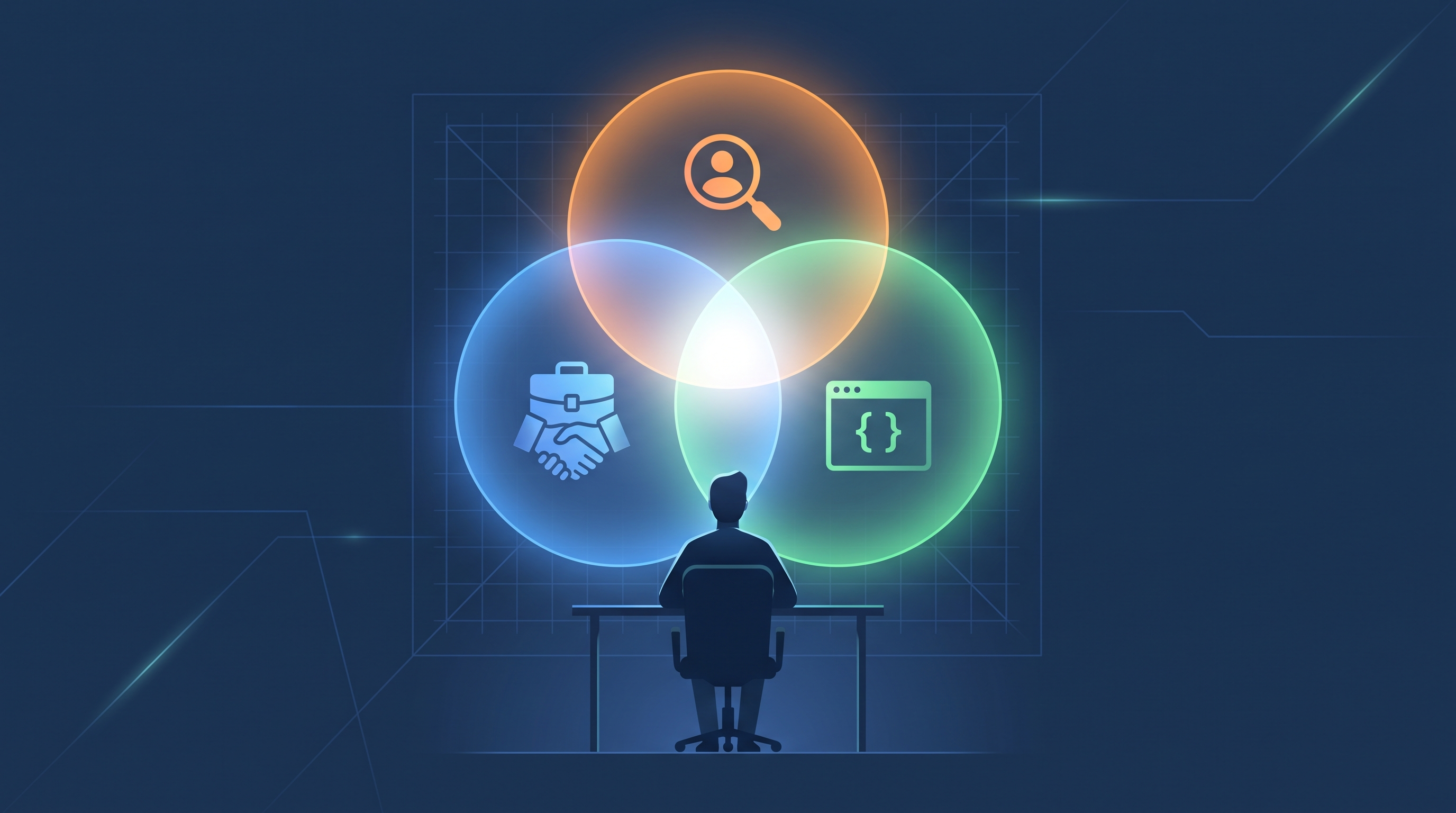
A product builder is someone who can do all three things a shipped product actually requires: judge what is worth building, build it themselves well enough to ship, and know when to cut scope based on what real users do. Most people are strong in one of the three and passable in another. The role exists because AI and no-code tools removed the excuse for not having all three.
Why the role exists now, and why it didn't ten years ago
Ten years ago, shipping a working product needed a team: someone to decide what to build, someone to build it, someone to decide when it was good enough to ship. The cost was the bottleneck, so companies hired around it, one person per function, and handed the idea across desks until it either survived the handoffs or died in one of them.
That bottleneck is mostly gone. A single person with an AI coding tool or a no-code builder like Base44 can turn a rough idea into something a real user can click through in an afternoon, what people now call vibe coding: prompting software into existence rather than typing every line by hand. Building a web app without writing code and scoping an MVP with AI tools cover the mechanics of that shift in more detail. What used to take a team and a sprint now takes one person and a weekend.
Removing the bottleneck did not remove the job, it relocated it, from typing the code to deciding what is worth typing in the first place. The YC Startup Library's playbook for AI-native companies makes the same point directly: the companies getting a real edge from AI tools are not the ones typing fastest, they are the ones with the clearest judgment about what to build.
What a product builder is not
A product manager who learned to prompt an AI tool still is not a product builder if they have never personally hit the wall where an idea turns out to be three days of real engineering work. Describing a feature clearly is not the same as knowing what it costs to build, and prompting a tool to build it is not the same as understanding why it broke.
A full-stack engineer with a good idea has the opposite gap. Plenty of technically capable people can ship a working app and still misjudge who would pay for it, what it should cost, or why an almost identical product from a bigger competitor already failed at the same thing. Marty Cagan's work at Silicon Valley Product Group makes a related point about product teams generally: strong products need business, technology and user judgment together, not one strong lens compensating for two blind ones.
A founder who has the vision and hires out the execution is closer to a manager than a builder. Paul Graham's essay on what he calls founder mode argues that founders who stay close enough to the actual product to notice what a status report would smooth over make different, usually better, calls than founders who manage through layers. A product builder stays that close by default, because they are the one building it.
The business skill: knowing what's worth building
The business skill is deciding what is worth building before any code exists: who has this problem badly enough to pay for a fix, what they are using instead right now, and what would actually make them switch. What Is Product-Market Fit? A Definition for Builders covers the signal that tells you this judgment was right. Web App Go-to-Market Strategy: What to Do Right After Launch covers what happens once you have shipped and have to find out for real.
This is the skill most engineers-turned-builders skip, because it is the one that cannot be automated by a better prompt. An AI tool will happily build the wrong product to a very high standard. It has no opinion on whether anyone needs it.
The implementation skill: shipping it yourself, not handing it off
The implementation skill is turning the decision into a working thing without waiting for someone else's sprint. That does not require writing every line of code by hand anymore. The wider shift toward vibe coding means a product builder's real implementation skill is closer to scoping and directing than typing.
How to Scope an MVP: A Product Consultant's Framework and How to Scope a Software Project as a Small Business cover the actual mechanics: cutting a build down to something small enough to finish in days, not months, and knowing which corners are safe to cut and which ones come back to bite you later. A product builder who cannot scope tightly ends up with the same bloated, half-finished build an AI tool alone would produce if you let it run without direction.
The product judgment: cutting scope and reading real users
Product judgment is the ability to cut scope based on what a real user actually does, not on what seems obviously important in a planning meeting. It decides whether the thing that got built and shipped actually gets used, which is a different question from whether it works.
Building tools cannot shortcut this part, because it only shows up after a real person tries to use the thing. A product builder watches the first ten users closely enough to see exactly where it breaks, then narrows the product instead of adding another feature to compensate. Watching stops being interesting right after the demo lands, and that is exactly the moment to watch hardest, because the version that impressed the room and the version that survives a stranger's first ten minutes are rarely the same product. The micro-SaaS go-to-market approach leans on the same discipline once the product ships and the real test starts.
Why cheaper tools raised the bar instead of lowering it
Cheaper building raised the bar for a product builder instead of lowering it, because the failure mode is no longer a product that took a year and never shipped, it is ten products that shipped in a month and none of them solved anything. When the cost of being wrong about what to build stays roughly flat while the cost of building collapses, being wrong gets a lot more frequent.
AI tools do not replace the judgment call about what to build or the discipline of talking to the people who are supposed to use it, they just mean you find out you were wrong faster and cheaper, which is only useful if someone is actually watching closely enough to notice.
The failure modes: strong in one skill, missing the other two
Someone strong on business but weak on implementation ends up with a well-reasoned deck and no product, because every idea has to go through someone else's queue before it can be tested. Someone strong on implementation but weak on business ships fast and often, and most of what they ship solves a problem nobody was paying for. Someone strong on product judgment but weak on implementation can tell you exactly what to cut from a build they are not fast enough to finish before the window to test it closes.
Each gap is fixable, but it takes admitting which one is actually missing instead of getting better at the two you already have. Getting faster at implementation just means shipping more of the wrong thing, faster, not fixing the business-judgment gap underneath it.
How to tell if you're already a product builder, or start becoming one
A simple check: have you personally shipped something a stranger used, decided what it should do based on watching them use it, and cut a feature you liked because the evidence said to? If you can point to a real instance of all three, you are already doing the job, whatever your title says.
If you are missing one, the fastest way in is usually not more theory. Pick a problem small enough to finish in a week, use whatever no-code or AI tool gets you there fastest, and force yourself to watch a real person use it before you build anything else. The three skills are learned in that order because each one only teaches you something once the previous one produced a real result to react to.
Key takeaways
- A product builder needs three skills together: knowing what is worth building, being able to build it, and knowing what to cut based on real use. Missing one is not a personality quirk, it is a gap.
- Cheaper building tools raised the bar for judgment instead of lowering it, because being wrong about what to build now happens faster and more often.
- Prompting a tool to build something is not the same skill as deciding whether it should exist.
- The fastest way to close a skill gap is a small, finishable build watched closely, not more research.
- Watch what a shipped product actually does in a stranger's hands, not just how impressive it looked in the room where you built it.
Definitions
Product Builder: Someone who combines business judgment, hands-on implementation ability, and product judgment to decide what is worth building, build it, and know when to cut it based on real usage, rather than relying on a team to supply the skills they lack.
Vibe Coding: Building software by prompting an AI tool in natural language and iterating on the result, rather than writing code by hand line by line; a term popularized by AI researcher Andrej Karpathy.
Empowered Product Team: A team structure, described by Marty Cagan, where a small group holds business, technology and user-experience judgment together rather than splitting those decisions across separate roles that hand work to each other.
Founder Mode: A concept from Paul Graham's essay of the same name describing founders who stay directly involved in product and execution details rather than managing purely through delegated layers.
Product Judgment: The ability to decide what to cut, ship, or change based on how real users actually behave, rather than internal opinion or planning-meeting consensus.
Frequently asked questions
What is a product builder?
A product builder is the person who owns all three decisions a shipped product needs: that it is worth building, that it actually got built, and what to cut once real people use it. Those three decisions used to sit with three different people, a strategist, an engineer and a product owner, and increasingly now sit with one.
Is a product builder the same as a product manager?
Not exactly. A traditional product manager decides what to build and hands it to engineering to implement. A product builder does both: they make the call and build the thing themselves, using AI or no-code tools where that is faster than hand-coding. The judgment is the same skill, the implementation is now personal instead of delegated.
Do I need to know how to code to be a product builder?
Not in the traditional sense. Tools like Base44 and AI coding assistants let a product builder ship a working product through prompting and configuration rather than writing every line of code by hand. What is still required is the judgment to scope it correctly and the discipline to fix what breaks once real users try it.
What skills does a product builder need?
Three, together: business judgment (knowing what is worth building and who would pay for it), implementation ability (shipping it without waiting on someone else's queue), and product judgment (cutting scope based on real usage instead of opinion). Most people are strong in one and weak in the other two.
Why is the product builder role becoming more common now?
Building software used to require a team, which meant the three skills, business, implementation, product judgment, could live in three different people. AI and no-code tools removed that requirement, so one person can now do all three, and the market increasingly expects them to.
Can AI tools replace a product builder?
No. AI tools remove the excuse for not being able to build something yourself, but they do not have an opinion on whether anyone needs what you are building, and they cannot watch a real user get stuck for you. The judgment calls still belong to a person, they just get tested faster now.
How do I become a product builder?
Pick a problem small enough to finish in a week, build it yourself with whatever no-code or AI tool gets you there fastest, and watch a real person use it before you add anything else. Most people reach for a course or a book first, which is backwards: the reading lands a lot better after your own build has broken in a real, specific way you can compare it to.