
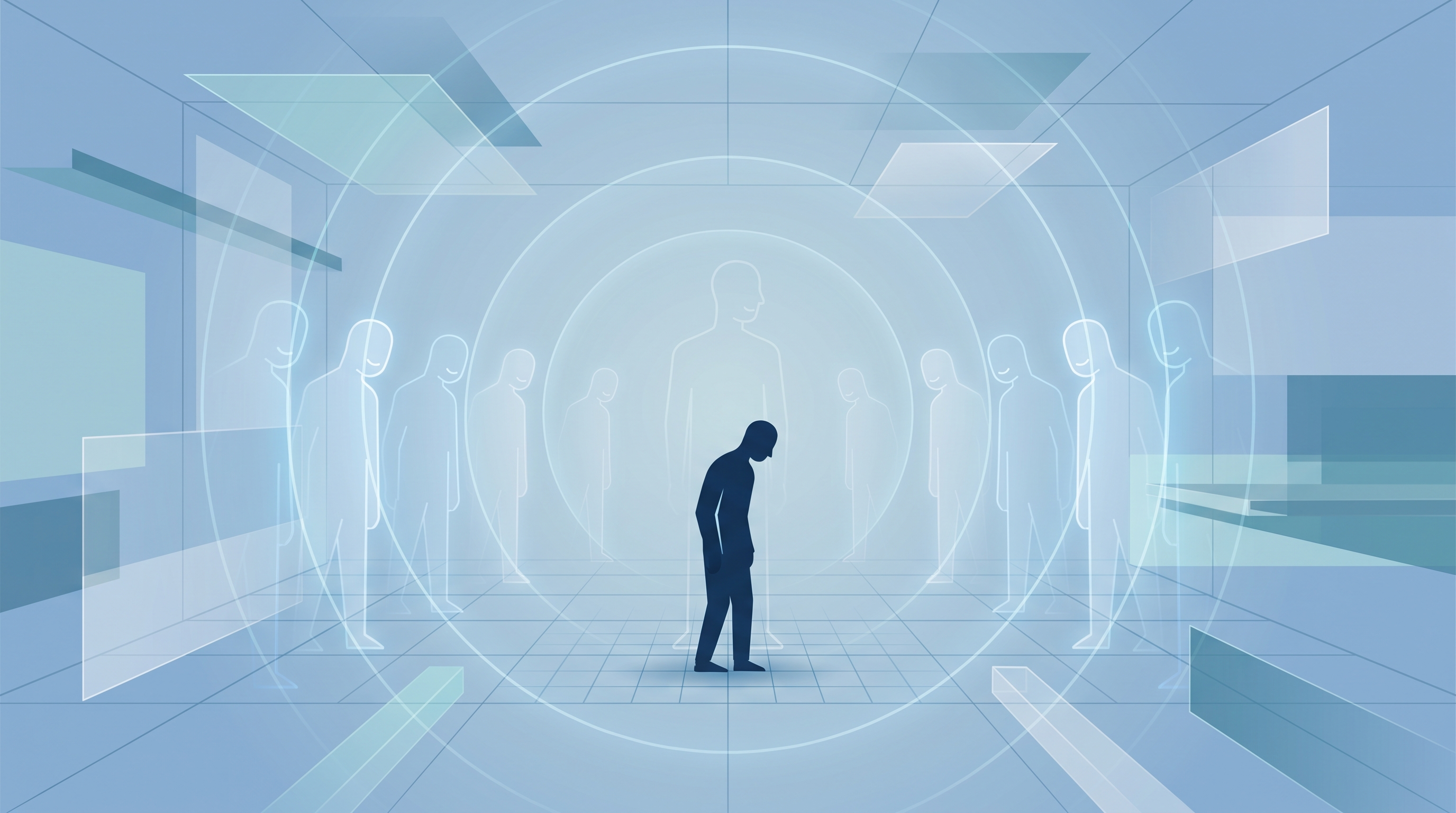
You agreed to the deadline you knew was wrong the moment it left your mouth. You said "sounds good" in the meeting, then spent the walk back to your desk redesigning the plan in your head, alone, where it was safe to disagree. You have shipped things you didn't believe in because saying so out loud felt more expensive than staying quiet. None of that was a decision. People-pleasing patterns made it for you, and they have been making decisions on your behalf for years.
This is for the product people, engineers, and founders who pride themselves on being logical, evidence-driven, and easy to work with, and who have started to notice that "easy to work with" has quietly become their entire personality at work. The tech industry rewards this trait so consistently that it stops looking like a pattern and starts looking like professionalism. That's worth pulling apart from what it actually costs you.
The short answer
People-pleasing patterns are not personality traits, they're a nervous-system strategy called fawning: agreeing, accommodating, and self-editing to stay safe around other people, formed early and triggered automatically under any hint of conflict or disapproval. The pattern runs faster than conscious choice, which is why it feels like "just how you are" rather than something acting on your behalf. The cost shows up as shrunken opinions, eroded judgment, and a body that has been quietly absorbing what your mouth didn't say.
Why the tech industry is a near-perfect habitat for this pattern
A culture built on being agreeable, aligned, and endlessly available gives a fawn response every condition it needs to thrive. Stand-ups reward the person who says "no blockers." Performance reviews reward the person who never pushes back on scope. A founder who built their identity on being easy to work with gets more opportunities, right up until the moment their actual judgment is the thing the team needed and never got.
The industry also prizes being logical and unemotional, which makes an emotional pattern nearly invisible while it runs the show. You can rationalize almost any accommodation as being reasonable, low-ego, or a good teammate. That rationalization is exactly what a fawn response needs to keep operating without ever being named.
There is also a specific reward loop in how tech companies measure people early in their careers. Junior engineers and product hires get told, directly or through the promotion cycle, that being a "team player" who absorbs scope changes without friction is what gets you staffed on the next project. That reward is real. It is also exactly the training a fawn response needs to generalize from one team to every relationship you have.
People-pleasing is a strategy, not a trait
The fawn response is a survival strategy, described by psychotherapist Pete Walker alongside fight, flight, and freeze: when conflict or disapproval reads as unsafe, the nervous system's fastest exit is to appease, agree, and make the other person comfortable before they even notice tension. It usually forms early, often in a house where a parent's mood set the temperature of the whole room, and it gets reinforced every time appeasing actually worked.
What makes it hard to catch as an adult is that it doesn't feel like fear. It feels like being nice, being easy, being the reasonable one. The nervous system isn't asking you whether you agree. It is asking whether the room is currently safe, and it has already decided the fastest route to safe is your agreement.
What people-pleasing patterns actually cost, cut by cut
Naming the mechanism is the easy part. The real work is looking honestly at the bill, because a fawn response never presents itself as a single cost, it presents as a dozen small ones that never get added up.
The first cost: losing your own read on things
Every time you swallow a disagreement to keep the room comfortable, you are training yourself out of trusting your own read. Do this for a few years and you stop being someone with an opinion who sometimes withholds it, and become someone who genuinely isn't sure what they think anymore, because the muscle for forming an independent view has gone unused.
This is expensive in product work specifically, where the whole job is judging what's worth building and cutting what isn't, and that judgment cannot survive on a diet of constant agreement. Someone who has trained themselves to align first and evaluate second will ship whatever the loudest person in the room wanted, then call it a decision. Ask yourself honestly how many of your last ten technical calls were actually yours, and how many were the path of least resistance dressed up as consensus.
The second cost: shrinking yourself until there's less to object to
Shrinking shows up in specifics: the technical opinion you don't share because a senior engineer might disagree, the feature you know is wrong but build anyway, the raise you don't ask for because the conversation might get uncomfortable. Each one looks small and reasonable in isolation.
Stacked over a career, they add up to a person who takes up noticeably less space than the one who started, and who other people have started to talk over without ever quite deciding to. Colleagues rarely notice this happening to someone else in real time. They only notice the absence, once, at the exit interview, when the reasons finally come out.
The third cost: "doing, doing, doing" as a disguise
Constant output is one of the fawn response's favorite disguises, because busy looks like value and nobody questions it. If you cannot say no, the only lever left is to prove your worth by doing more, faster, without ever pausing to ask whether the work is right.
The same trap shows up on the product side: cutting scope down to something small enough to finish requires saying no to good ideas, and a person who cannot say no in their own life is not going to be the one in the room saying no to the roadmap either. The tell is simple: does your calendar reflect your priorities, or everyone else's requests, arranged in the order they arrived?
The fourth cost: a shrinking range of personal expression
The opinion you don't voice in the meeting is also the boundary you don't set with your partner and the preference you don't state when choosing where to eat. It is the same muscle, atrophying everywhere at once, not compartmentalized to work the way people like to believe.
Physician and author Gabor Maté has written at length about what happens when authentic expression is chronically suppressed to keep others comfortable: the feeling doesn't disappear because it wasn't spoken, it goes somewhere, and that somewhere is usually the body. A person who has practiced self-editing for a decade often cannot answer a simple question like "what do you actually want here" without a pause that surprises them.
What the body is quietly carrying
I believe the body remembers what you didn't say long before your mind catches up to it. Louise Hay's body-mind framework won't diagnose you, and I'm not using it that way here. I'm using it the way I use it in my own practice: as a question worth sitting with, not an answer. A few of its patterns map onto fawning with uncomfortable precision.
A tight, closing throat often shows up in people who have trained themselves not to say the thing. Chronic tension across the upper back and shoulders often shows up in people who have quietly decided it's their job to carry what everyone around them is feeling. A jaw that clenches through the night is a common place for a "no" that never got to leave the mouth during the day.
None of this is a claim about what caused anyone's specific symptom, and it isn't a replacement for actually seeing someone about it if it persists. It's an invitation: if a part of your body has been complaining for a while, it may be worth asking what you have been agreeing to that you didn't actually agree with.
Why simply "being more assertive" doesn't work
Most advice on this stops at "just say no," which fails because it treats a nervous-system reflex like a communication-skills gap. You already know how to say no in the abstract. The fawn response fires before the part of you that knows that gets a vote, the same way flinching happens before you decide to flinch.
What actually works looks like scoping any hard problem down to something finishable: not overhauling everything at once, but picking one small, specific instance and practicing a different response there until it stops requiring conscious effort. Say the mildly uncomfortable true thing in a low-stakes meeting this week. Then a slightly higher-stakes one next week. Nervous systems change through repeated small evidence that disagreement didn't end in disaster, not through a single decision to be different.
Most people never watch their own pattern closely enough to catch it firing, because by the time they notice, the agreement has already left their mouth. Start noticing the half-second before you say yes instead. That's where people-pleasing patterns live, and it's the only place you can actually catch one before it acts on your behalf again.
Working through this pattern, not just reading about it
Naming a pattern on a page is not the same as unwinding it in your own body, and most of what's described above sits below the level language can reach by itself. This is the part I work with people on directly, not talking about the fawn response in the abstract, but sitting with where it actually lives in you, in real time, so agreeing has less of a monopoly on how you move through your own work.
The approach I use is somatic and emotional rather than purely cognitive, because a reflex that formed in the body rarely resolves through insight alone. You can understand the fawn response perfectly and still feel your shoulders climb toward your ears in the next meeting where you disagree. That gap between understanding and actually changing is exactly where somatic work operates.
If you recognized yourself somewhere on this page, in the meetings that leave you more tired than the work justified, in the opinions you've quietly stopped forming, in a calendar that reads like everyone else's requests, that recognition is usually the first honest evidence something is ready to move. I work with people on exactly this: staying yourself inside a career that keeps asking you not to. You can find me at omernisim.com if that's a conversation worth having.
Key takeaways
- People-pleasing patterns are a nervous-system strategy called fawning, not a personality trait, and they fire faster than conscious choice.
- Tech culture rewards agreeableness and constant availability, which makes the pattern nearly invisible while it runs.
- The cost compounds across judgment, self-expression, and the body, not just in obvious conflict-avoidance moments.
- Constant busyness is often the pattern in disguise: proving worth through output because saying no isn't available.
- Change comes from practicing a different response in one small, low-stakes moment at a time, not from a single decision to be more assertive.
Definitions
Fawn Response: A nervous-system survival strategy, alongside fight, flight, and freeze, that responds to perceived threat by appeasing, agreeing, and prioritizing another person's comfort.
People-Pleasing Pattern: A learned behavioral habit of consistently prioritizing others' approval or comfort over one's own needs, opinions, or boundaries.
Boundary: A stated limit on what a person will accept, do, or tolerate, communicated before resentment forces the point instead.
Body-Mind Correspondence: A framework, associated with Louise Hay, that treats certain physical patterns as reflections of emotional or mental patterns, offered as a lens for reflection rather than a medical explanation.
Frequently asked questions
What causes people-pleasing patterns?
People-pleasing usually forms early, often in an environment where a caregiver's mood or approval felt unpredictable, and appeasing them was the fastest way to feel safe. The nervous system learns that strategy works and keeps using it into adulthood, long after the original threat is gone, which is why it can feel automatic rather than chosen.
Is people-pleasing the same as being a fawn trauma response?
Fawning is the clinical name for the pattern commonly called people-pleasing. Psychotherapist Pete Walker described it as a fourth trauma response, alongside fight, flight, and freeze, distinguished by appeasement and self-erasure rather than confrontation or avoidance. The everyday word describes what it looks like from the outside; the clinical one describes what is actually happening in the nervous system underneath it.
How do I know if I'm a people-pleaser or just easygoing?
Being genuinely easygoing means you have a preference and don't mind flexing it. People-pleasing means you have trained yourself out of noticing you had a preference at all. A useful check: can you name the last time you disagreed with someone whose approval mattered to you, and stayed with the discomfort instead of walking it back?
Does people-pleasing get worse during high-pressure periods, like a crunch or a fundraise?
Yes, for most people the pattern intensifies exactly when stakes rise, because a nervous system reads high pressure as more threat, not less. Founders and product leads often report their worst boundary-setting during exactly the stretches when clear judgment matters most: a funding push, a launch week, a reorg. That timing is precisely why the pattern is expensive rather than harmless.
How does people-pleasing affect work performance, specifically in tech?
People-pleasing erodes independent judgment over time, because judgment requires practicing disagreement, and a fawn response avoids exactly that. In product and engineering work, this shows up as agreeing to unrealistic scope, building features you privately doubt, and staying quiet in the meeting where your actual opinion was the most useful thing in the room.
How long does it typically take to shift a people-pleasing pattern?
There's no fixed timeline, and anyone offering you an exact number of weeks is selling something. Because the pattern lives in the nervous system rather than in belief, it changes through months of repeated small evidence that disagreement is survivable, not through one insight or one hard conversation. Most people notice the reflex loosening before they notice it's gone.