
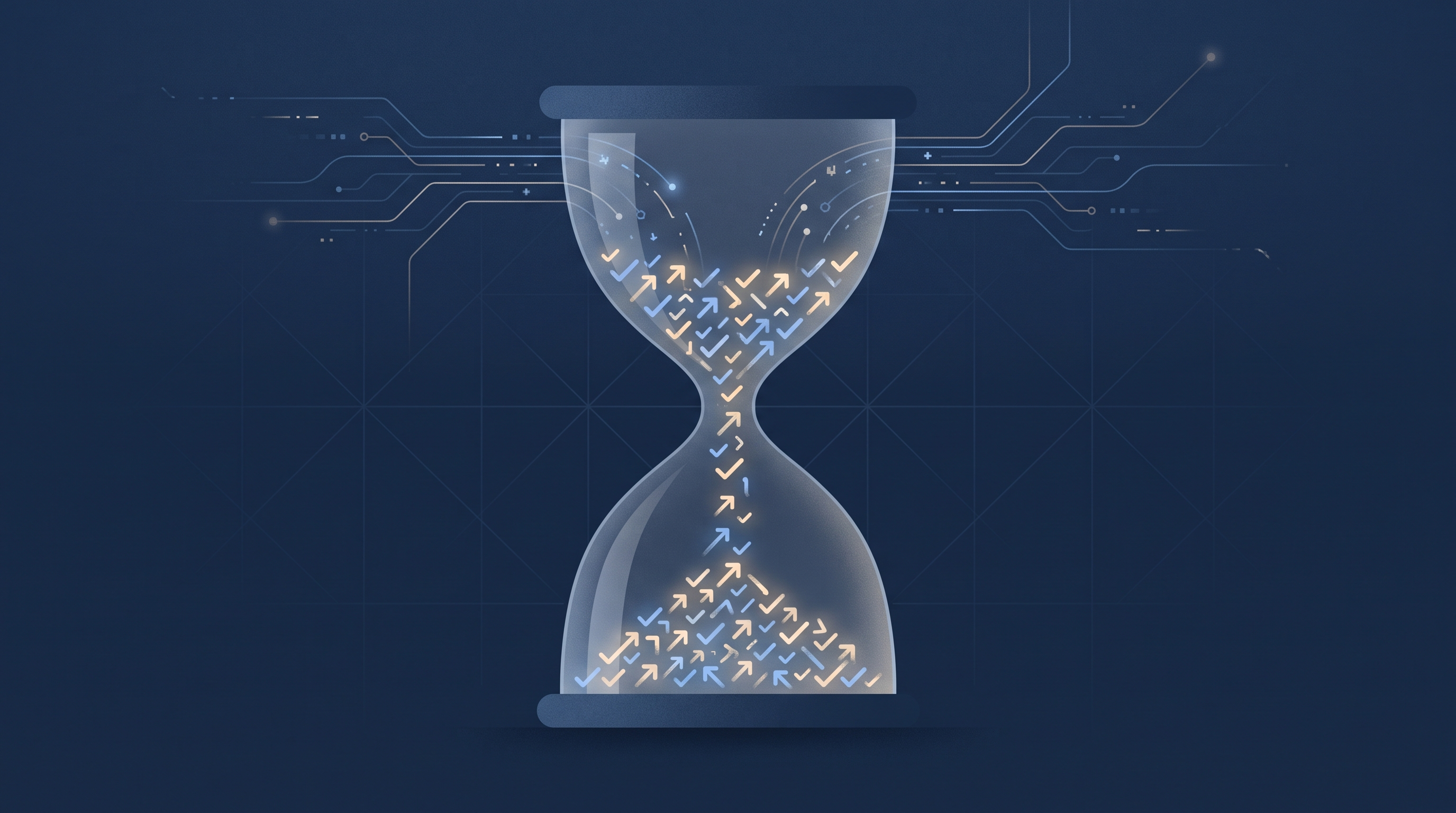
Chronic Productivity: Why the Illusion of Doing Can Be Toxic
You finish a task and the relief lasts about four minutes before the next one presents itself, uninvited. That's not discipline. That's chronic productivity: a compulsive need to keep producing, where the doing isn't in service of a goal anymore, it's in service of a feeling you're trying not to have. Toxic productivity has a specific engine under it, and naming the engine matters more than any tip about time-blocking, because the tips assume the problem is your schedule. It usually isn't.
This is for builders, founders, and product people who suspect their relationship to work stopped being about the work a while ago. It's also, more urgently, for anyone who's noticed that AI tools were supposed to free up their time and somehow didn't.
The short answer
Chronic productivity is a pattern where output becomes proof of worth rather than a response to an actual need, so the doing never resolves, it just moves to the next task. The emotional engine underneath is usually one of a few beliefs held quietly and rarely said out loud: I am not enough as I am, if I stop producing I lose my right to take up space, or I have to justify my existence through what I get done today. AI agents make this worse rather than better, because delegating a task to an agent removes the doing but not the anxious oversight underneath it, so people end up managing more work while feeling like they're doing less.
What chronic productivity is, and what it isn't
Chronic productivity isn't the same as being busy, and it isn't the same as working hard on something that matters to you. The difference is what happens when you stop. A busy season ends and you feel tired but fine. Chronic productivity ends, or gets interrupted, and something closer to dread shows up: a felt sense that stopping is dangerous, even when nothing bad is about to happen.
Toxic productivity is the term psychologists use for this: an unhealthy relationship to output where doing more gets pursued well past the point of usefulness, often at real cost to health, relationships, and the judgment that would normally tell you when to stop. Chronic productivity is the daily, habitual version of that: not one bad sprint, but a baseline state where rest reads as a threat instead of a need.
The emotional engine: what the doing is proving
Underneath most chronic productivity sits a belief that rarely gets said in plain language, because saying it out loud makes it sound as harsh as it feels: I am not enough as I am, so I have to earn the right to exist today through what I produce. That belief doesn't announce itself. It shows up as a low hum of unease the moment a task list empties, and it resolves the instant a new task appears, which is exactly why the pattern is so hard to see from inside it. Relief that reliable feels like proof the system is working, not evidence that something's off.
A second, related belief does similar damage: if I'm not producing, I have no right to the space I'm taking up, whether that space is a seat on a team, a place in a market, or just an afternoon with nothing scheduled. This is what makes chronic productivity different from ambition. Ambition points toward something you want. This points away from a feeling you can't sit with, and it will keep pointing away from it for as long as the belief goes unexamined, no matter how much gets shipped in the meantime.
The cruelest version of this shows up as identity substitution: your worth and your output quietly merge into the same thing, until a slow week doesn't just feel unproductive, it feels like evidence you don't deserve what you have. Nobody chooses this consciously. It gets built one deadline, one approval-seeking sprint, one "I'll rest once this is done" at a time, and by the time it's load-bearing, it looks indistinguishable from a strong work ethic.
Why AI agents are making this worse, not lighter
The promise of an AI agent is that it does the task so you don't have to, and for a narrow, mechanical slice of work, that's true. What isn't true is that delegating the task removes the reason you were doing it compulsively in the first place. If the underlying drive was never really about the task, getting the task done faster doesn't quiet the drive, it just frees up capacity for the drive to find something else to do. Building got cheaper across every one of these tools, but the judgment for when to stop was never part of what any of them sell.
In practice, that's exactly what happens. You tell an agent to handle something, and instead of the freed time turning into rest, it turns into three more things you now have bandwidth to also start. The felt experience is of doing less, because your hands are on the keyboard less. The actual experience, measured by what's occupying your attention, is closer to doing more, just distributed across more open loops at once.
This isn't a hunch. In Microsoft's 2026 Work Trend Index, 65% of AI users say they fear falling behind if they don't keep adapting to the tools fast enough. That's not the anxiety of someone with less to do. That's the anxiety of someone who has quietly added "staying ahead of the tool" to an already full plate, and it's a specific, avoidable cost of exactly the pattern this article is about.
The math nobody runs: managing an agent isn't free
Overseeing an AI agent is its own cognitive job, and it never shows up on a task list. You have to specify the task clearly, check the output, catch what it got wrong, redirect it, and hold the whole thread in your head until it's done, not just technically finished. None of that is doing in the old sense, typing and building by hand, but all of it uses the same limited attention that doing used to use.
For someone with a chronic productivity pattern, this is close to a perfect trap. It feels lighter. It isn't. The tool creates the appearance of doing less, while the actual brain load, the obsessive checking, the mental tab that stays open until the agent reports back, barely drops at all. You end up spending more total brain power managing and worrying about work than you did when you were simply doing it yourself, because now you're doing the task's thinking and the manager's thinking on top of it, often on three or four threads in parallel.
What this pattern costs you
The price of chronic productivity is rarely visible while you're paying it, which is part of what makes it sustainable for so long before something breaks. A few of the costs are concrete enough to name plainly.
Your nervous system pays first. A baseline state of low-grade urgency, sustained for months, is exactly the pattern the WHO classifies as a driver of occupational burnout when workplace stress goes unmanaged long enough. It doesn't announce itself as burnout at first. It shows up as trouble sleeping the night before nothing in particular, or a body that can't settle even when the schedule is technically clear.
Your thinking pays second. The kind of judgment that lets you spot the one thing actually worth building, instead of the ten plausible things, needs unstructured time to work in the background. Harvard Health has documented how a schedule with no slack in it directly undermines the well-being that clear thinking depends on. A calendar with no open space doesn't just feel exhausting, it removes the exact condition your best decisions were made in.
Your relationships pay third, more quietly than the other two. Presence isn't divisible the way tasks are. A parent, partner, or friend can usually tell within a few minutes whether you're actually there or running a background process about the thing you should be doing instead, and chronic productivity guarantees you're running that background process almost everywhere.
And your sense of self pays last, which is the cruelest part, because the whole pattern started as an attempt to protect it. When worth is contingent on output, a bad week doesn't just cost you the output. It costs you the temporary belief that you were allowed to exist without earning it, and that belief has to be re-earned all over again the next morning.
How this shows up specifically for builders and founders
Founders and product people have a version of this that's easy to mistake for good instincts. Shipping fast, staying close to users, moving before the market moves, all of that is genuinely part of the job, which is exactly what makes the compulsive version so well camouflaged. The tell isn't the pace. It's what happens in your body the moment there's nothing left to ship.
If a genuinely quiet day, no fires, no launches, nothing urgent, produces something closer to dread than relief, that's the pattern talking, not the market. A real constraint tells you what to build next. An anxious identity tells you to build something, anything, so the discomfort of stillness has somewhere to go. Those two signals feel almost identical from the inside and point in completely different directions.
What breaks the pattern
Breaking chronic productivity doesn't start with doing less, because "do less" is advice aimed at behavior when the actual driver is a belief. It starts with noticing the specific thought that fires the moment output stops: I'm not enough, I don't have the right to this space, I have to justify being here. That thought is rarely accurate, and it almost never survives being said out loud to another person instead of just felt alone at 11pm.
The practical version of this is smaller than it sounds: build in a stretch of unstructured time on purpose, and pay close attention to what comes up in your body when it arrives. Not what you think should show up. What actually does. That discomfort, if it's there, is the real signal, and it's telling you something a shipped feature never will.
Key takeaways
- Chronic productivity is output used as proof of worth, not a response to an actual task, which is why finishing something rarely brings lasting relief.
- The core beliefs driving it are usually some version of: I'm not enough, I have no right to this space, or I have to justify my existence through what I produce today.
- AI agents remove the doing but not the anxious oversight underneath it, so delegated work often adds a second, invisible layer of managing and worrying on top of the original task.
- The WHO classifies burnout as an occupational phenomenon rooted in chronically unmanaged workplace stress, and chronic productivity is one of its most common on-ramps.
- The pattern breaks by noticing the specific belief behind the compulsion to keep doing, not by scheduling more discipline on top of it.
Definitions
Chronic Productivity: A sustained, compulsive need to keep producing where output functions as proof of worth rather than a response to an actual need.
Toxic Productivity: An unhealthy relationship to output where doing more is pursued past the point of usefulness, often at real cost to health, relationships, and judgment.
Occupational Burnout: A syndrome resulting from chronic workplace stress that has not been successfully managed, officially classified by the WHO as an occupational phenomenon rather than a medical condition.
Contingent Self-Worth: A psychological pattern in which a person's sense of value depends on ongoing achievement or output rather than existing independently of it.
Frequently asked questions
Is chronic productivity the same as being a hard worker?
No. A hard worker is directed at a goal and can stop when the goal is met or the day ends. Chronic productivity is directed at an underlying feeling, usually inadequacy or fear of not deserving rest, so stopping doesn't feel like completion, it feels like exposure, regardless of how much got done.
Why does using AI tools make me feel busier instead of freer?
Because delegating a task to an AI agent removes the manual work but not the oversight: specifying it clearly, checking the output, catching mistakes, and holding the thread until it's genuinely finished. That oversight uses the same attention doing used to use, so the freed time often fills with more open loops instead of rest.
What's the difference between chronic productivity and ambition?
Ambition points toward something you want to build or achieve. Chronic productivity points away from a feeling, usually inadequacy, that shows up the moment output stops. They can look identical from the outside, but ambition tolerates a quiet day. Chronic productivity treats a quiet day as a threat.
Can chronic productivity lead to burnout?
Yes, and it's one of the more common paths there. The WHO classifies burnout as resulting from chronic workplace stress that hasn't been successfully managed, and a baseline state of compulsive doing, with no real recovery between tasks, is exactly that kind of unmanaged stress sustained over time.
How do I know if my productivity has become compulsive?
Notice what happens in your body the moment a task list genuinely empties. Relief and a bit of tiredness is a normal response to real work. Restlessness, unease, or an urge to immediately find the next thing is usually the compulsive version, especially if it shows up even when nothing urgent is pending.
Does slowing down actually fix this, or is that oversimplified advice?
Slowing down alone rarely fixes it, because the compulsion is driven by a belief, not a schedule. Blocking off unstructured time is useful, but the real work is noticing what specific thought or feeling shows up when the doing stops, since that's the thing running the pattern.